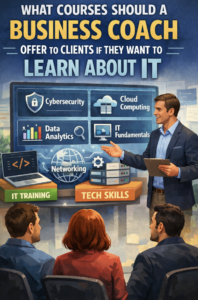
Modern businesses do not treat technology as a back-office utility anymore. IT decisions now shape revenue, customer experience, risk exposure, hiring plans, and valuation. A business coach who can guide clients through the right IT learning path becomes more than a motivator or accountability partner. That coach becomes a strategic translator between business goals and the technology investments that make those goals real.
The strongest IT curriculum for coaching clients is not built around vendor tools or trendy buzzwords. It is built around business outcomes, with enough technical literacy to make smarter decisions, avoid expensive mistakes, and lead internal teams or external partners with confidence. This article lays out a course lineup a business coach can offer clients who want to understand IT through a business lens, using topics that track directly with what is happening in the IT economy and enterprise priorities today. Reference points like global IT spending forecasts, cybersecurity disclosure requirements, and AI adoption trends reinforce why these course areas belong in a modern coaching program.
Course 1: IT Fundamentals for Business Leaders
Start with a foundation that demystifies the language of IT without oversimplifying it. This course establishes the minimum technical vocabulary and mental models a business owner, executive, or manager needs in order to make sound decisions and communicate clearly with IT staff, consultants, and vendors.
Core modules include how data moves through a business, the difference between infrastructure and applications, how networks support operations, what “cloud” means in practical terms, and how IT teams typically structure responsibilities. Tie it to common business roles, including the executive seat that owns technology strategy, using a reference like Information technology. The goal is not to turn clients into technicians. The goal is to give them enough fluency to understand tradeoffs, timelines, constraints, and risks before they sign contracts or commit budgets.
Course 2: IT Strategy, Budgeting, and the Economics of Tech Decisions
Business clients need a course that makes IT spending feel like a controlled investment, not a mysterious cost center. This course teaches how to align IT initiatives to a one-year operating plan and a three-year growth plan, how to build a technology roadmap, and how to evaluate competing priorities when everything feels urgent.
Include budgeting frameworks that separate run-cost from change-cost, and emphasize total cost of ownership, not sticker price. Cover how to compare in-house versus outsourced models and how to measure ROI in ways that matter, such as revenue lift, margin protection, cycle-time reduction, and risk reduction. To anchor the conversation in real-world momentum, reference current market signals like Gartner’s forecast that worldwide IT spending is projected to reach $6.15 trillion in 2026, with AI infrastructure remaining a major driver, via Gartner’s 2026 IT spending forecast press release.
Course 3: Cloud and Modern Infrastructure for Growth
Most companies now operate in a blended environment, with some systems in the cloud and others still on-site or managed by third parties. A business-ready course should explain the major cloud service models, how cloud changes cost structures, and why cloud migrations often fail when the business does not define the destination clearly.
Teach clients how to choose between “lift and shift” versus modernization, how to plan for identity and access, and how to avoid runaway cloud costs by establishing tagging, usage policies, and budgeting guardrails early. Also include vendor management basics, since cloud is as much about contracts and service levels as it is about technology.
This course becomes even more relevant when clients are watching headlines about large-scale investment in AI infrastructure and cloud capacity. For example, Reuters has reported on the scale of Big Tech AI infrastructure spending expectations, which shapes pricing, competition, and downstream availability for businesses of all sizes, via Reuters coverage on major AI infrastructure investment expectations.
Course 4: Cybersecurity, Risk, and Board-Level Governance
Cybersecurity belongs in a business coaching IT curriculum because risk is now a business growth limiter. A single incident can freeze operations, damage trust, and trigger expensive legal and insurance consequences. Clients need a course that frames security as governance and resilience, not fear.
Teach a pragmatic model for building a cybersecurity program: asset awareness, identity management, patching discipline, backups and recovery, vendor risk, and incident response readiness. Use frameworks that business leaders can communicate across departments. A strong anchor is The NIST Cybersecurity Framework (CSF) 2.0, which provides a common language for outcomes and maturity without prescribing one specific implementation.
Also teach how disclosure and accountability are evolving in public markets, because it influences expectations even for private companies through insurers, lenders, and large customers. The SEC’s rules requiring disclosures around material cybersecurity incidents and cyber governance show how cyber risk has become a reporting issue, not just an IT issue, via SEC press release on adopted cybersecurity disclosure rules.
Course 5: Data, Analytics, and Practical AI Adoption
Clients want to “use AI,” but most organizations still struggle with data readiness, governance, and selecting use cases that pay back quickly. This course teaches how data strategy connects to revenue and efficiency, how to define reliable metrics, and how to build a simple analytics operating rhythm that leaders actually use.
Then it progresses into AI readiness: data quality, security, model risk, human review processes, and change management. Avoid turning this into a tool demo class. Teach clients how to choose use cases that protect margins, reduce cycle time, or improve customer experience, and how to measure outcomes without self-deception.
Use current enterprise signals to keep the course grounded. McKinsey’s research on the growing share of organizations reporting AI use can be used to contextualize why leadership literacy matters, via McKinsey’s The State of AI.
Course 6: Software Selection, Implementation Leadership, and Change Management
Many IT failures happen because the business does not lead implementation. This course teaches clients how to run technology projects like business transformations, including how to define requirements that match workflows, how to evaluate vendors, and how to structure pilots so they produce real learning rather than surface-level enthusiasm.
Cover implementation governance, stakeholder alignment, training, adoption metrics, and post-launch optimization. Include the disciplined practice of documenting decisions, assumptions, risks, and ownership. Most importantly, teach clients how to protect focus and prevent “tool sprawl” by enforcing standards around procurement and integration.
Since software investment is deeply tied to business performance and investor narratives right now, this course benefits from keeping a light touch on market realities such as uncertainty and disruption pressures in software segments, which are showing up in business reporting and market behavior.
Course 7: IT Operations, Vendors, and Service Management That Protect Time and Money
Clients do not only need strategy. They need stable operations. This course equips clients to run IT like a reliable business function, whether they outsource to a managed provider or build internal capability. Teach service-level expectations, ticketing discipline, documentation standards, onboarding and offboarding controls, and quarterly business reviews with vendors.
Include fundamentals of IT service management, basic compliance expectations, and how to design escalation paths that reduce downtime. Also include resilience planning, including backups, disaster recovery objectives, and communication plans.
To connect operational maturity with real financial impact, incorporate modern breach economics and why governance matters as AI expands. IBM’s research on breach costs and the risks around fast AI adoption provides strong business context via IBM Cost of a Data Breach Report 2025.
Course 8: Career and Team Literacy for IT-Adjacent Leaders
Many coaching clients are building teams. They need a course that helps them hire, manage, and evaluate IT talent and vendors without relying on gut feel. Teach what to look for in a fractional CIO, how to structure an internal IT manager role, and how to evaluate a security lead or a data leader. Teach how to write outcome-based role scorecards, not tool lists.
This course also covers communication rhythms between business and IT, including how to run project steering meetings and how to report progress in business language. It is the capstone course that turns IT understanding into leadership leverage.
Conclusion
What courses should a business coach offer to clients who want an IT education gives clients a durable edge: clearer decision-making, better vendor outcomes, stronger security posture, and a practical ability to adopt modern capabilities like cloud and AI without chaos. The most effective curriculum starts with shared language, then moves into strategy and economics, then into cloud, cybersecurity, data and AI, implementation leadership, operational excellence, and people leadership.
This course lineup keeps clients anchored to business outcomes while staying aligned with the realities shaping IT business priorities right now, including rising global IT investment forecasts, expanding AI infrastructure spending, and increasing governance expectations around cybersecurity.
